


Dream Makers - Science Fiction And Fantasy Writers At Work - Profiles
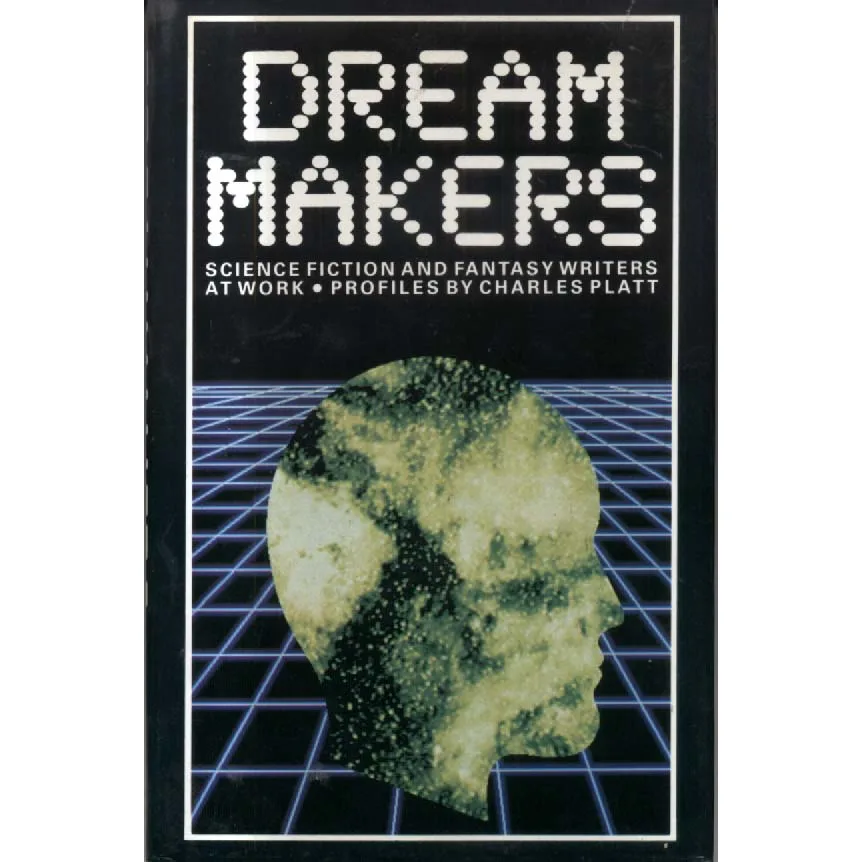
Publisher: Xanadu
Format: Hardback
ISBN: 9780947761141
One date note: most catalogues record this Xanadu edition, ISBN 9780947761141, as published in 1987, although it may carry a 1986 copyright date. I would use whichever year appears on your copy’s title/copyright page.
Science-fiction writers spend their working lives constructing alien civilisations, alternative histories, intelligent machines and methods of travelling faster than light. They generally perform this labour while sitting alone in ordinary rooms, surrounded by manuscripts, coffee and the suspicion that their publisher has forgotten them. In Dream Makers, Charles Platt visits the people behind the futures and asks how the machinery actually operates.
This collection presents profiles of twenty-eight major science-fiction and fantasy writers from Britain and America. Platt is interested not only in what they wrote but in how they lived, worked, argued and understood their peculiar profession. The result is literary biography conducted at close range, with the subjects still capable of objecting.
Among the writers featured are Isaac Asimov, Philip K. Dick, J. G. Ballard, Michael Moorcock, Frank Herbert, Brian Aldiss, John Brunner, Frederik Pohl, Theodore Sturgeon, Robert Silverberg, Kurt Vonnegut, Robert Sheckley, Algis Budrys, James Tiptree Jr and others. It is an impressive gathering of minds, several of whom would probably have resisted being gathered in the same physical room.
The pieces are more than straightforward question-and-answer interviews. Platt describes homes, mannerisms, working habits and personal atmosphere, combining conversation with observation to create compact portraits. He notices what the writers say, how they say it and occasionally what their surroundings suggest they might prefer not to say.
Isaac Asimov brings legendary productivity and confidence, having apparently concluded that sleep was an inefficient interruption to publication. Philip K. Dick offers a much less stable relationship with reality, identity and the economic rewards of genius. J. G. Ballard brings his cool fascination with modern landscapes and psychological catastrophe, examining civilisation as though it were an automobile crash arranged for research purposes.
Frank Herbert discusses the intellectual and ecological concerns behind his fiction, while Michael Moorcock represents the more rebellious traditions of British speculative writing. Brian Aldiss, John Brunner and others reveal the ambitions and disagreements that shaped science fiction as it moved beyond rockets, bug-eyed monsters and covers featuring women dressed unsuitably for vacuum.
Platt also explores the economics of writing. Literary imagination may be infinite, but rent remains stubbornly monthly. Some interviewees achieved fame, substantial sales and cultural influence; others produced books rapidly to survive within a market that rewarded quantity, reliability and the ability to complete a galactic war before the contractual deadline.
Editors, magazines and publishers appear throughout because science fiction was built not only by solitary authors but by a small and argumentative community. Friendships, rivalries, conventions and editorial policies determined which visions of the future reached print. The genre imagined post-scarcity societies while operating through advances, rejections and paperback royalty statements.
The profiles capture writers at particular moments in their careers. Some are established masters looking back; others remain in the middle of personal or professional upheaval. James Tiptree Jr presents a particularly fascinating case of identity and authorship, while writers such as Sturgeon and Pohl carry memories stretching back into the formative magazine culture of American science fiction.
Platt is not an invisible or reverential interviewer. Himself a science-fiction writer and former editor associated with New Worlds, he understands the field from within and approaches its celebrities without excessive ceremonial distance. He can be admiring, sceptical, sympathetic or sharply observant, sometimes within the same paragraph.
This candour distinguishes Dream Makers from a collection of promotional interviews. The writers are permitted to be brilliant, vain, insecure, generous, difficult and contradictory. Producing imaginative fiction does not necessarily make its creator agreeable, prophetic or capable of finding a clean cup in the kitchen. Platt appears relieved by none of this and surprised by very little.
The interviews originated in the work behind Platt’s earlier Dream Makers volumes, both acclaimed studies of the people creating modern science fiction. This revised selection brings many of the strongest profiles together, offering a remarkable snapshot of the genre during a period when its older pulp traditions, New Wave experiments and emerging literary ambitions uneasily shared the shelves.
Readers encounter not one explanation of science fiction but many. For some writers it is entertainment; for others it is social criticism, mythology, speculation or an instrument for taking reality apart. They disagree about style, politics, commerce and the responsibilities of the genre, thereby proving that science-fiction writers can imagine a united galaxy more readily than a united science-fiction community.
The book is valuable both as literary history and as a study of creative work. Aspiring writers may find encouragement in discovering that famous authors also experienced uncertainty, financial pressure and abandoned drafts. They may find less encouragement in discovering how many hours Asimov spent typing.
This will appeal to readers interested in classic science fiction, author interviews, literary biography and the culture surrounding speculative fiction. It is particularly fascinating now because several of its subjects have become canonical figures, safely transformed by history into dignified names on book spines. Platt restores the inconvenient human beings who occupied those names.
This copy is in Good condition, showing ordinary signs of previous ownership but remaining entirely suitable for further investigation of its inhabitants. Offered by Crappy Old Books, it is a lively, candid and occasionally mischievous journey into the lives of people who manufactured dreams professionally—usually while wearing ordinary clothes and worrying about the next cheque.
Keep browsing: See more Science-Fiction books Other books by Charles Platt
